Best Cooking Banana Varieties in Kenya: Characteristics, Yield and Growing Guide
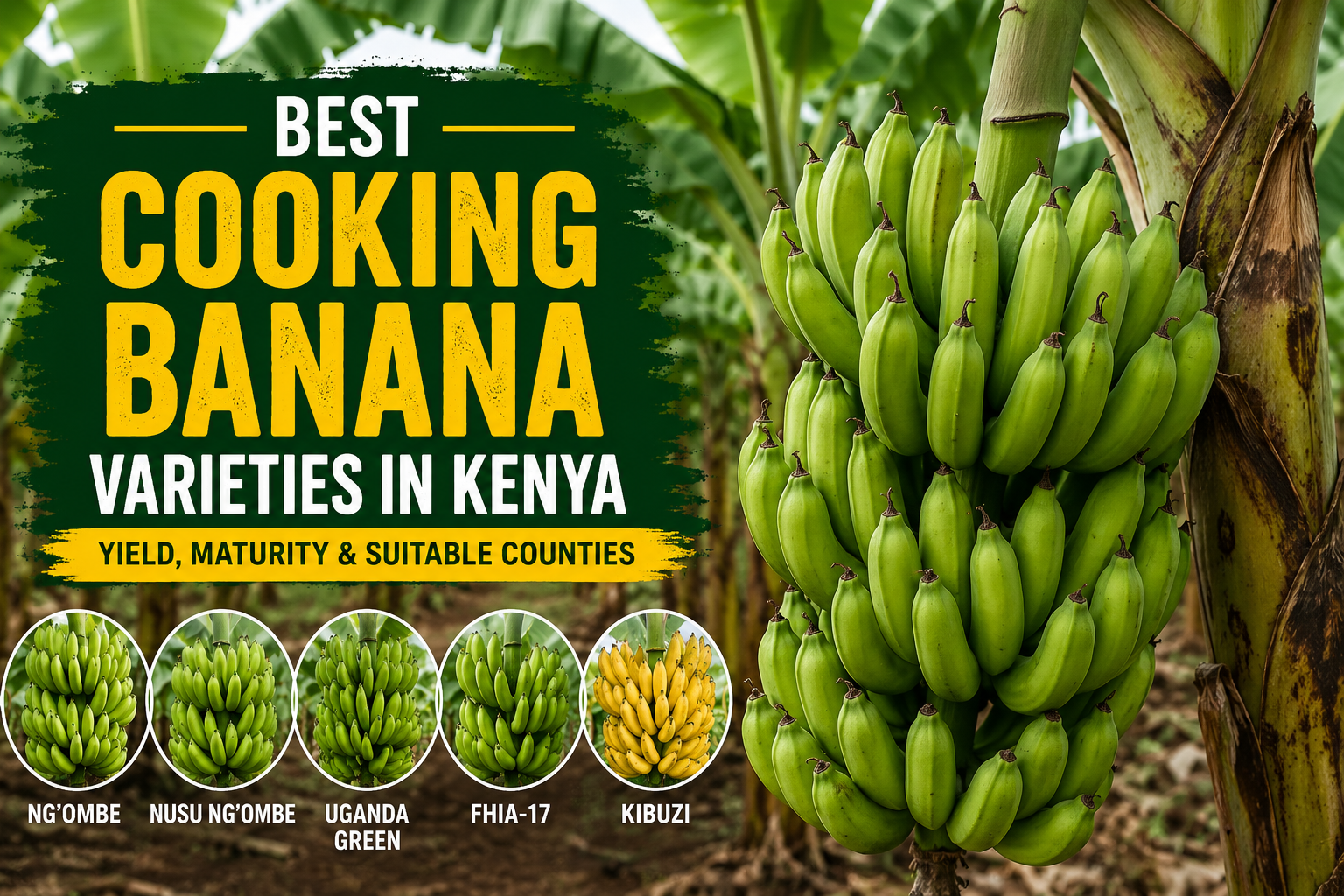
Cooking bananas are an important food and commercial crop in Kenya. They are commonly prepared as matoke, mashed with potatoes, boiled, fried, roasted or processed into products such as crisps and banana flour.
Cooking bananas are an important food and commercial crop in Kenya. They are commonly prepared as matoke, mashed with potatoes, boiled, fried, roasted or processed into products such as crisps and banana flour.
For farmers, selecting the right cooking banana variety is one of the most important decisions made before establishing an orchard. A suitable variety should match the farm’s climate and soil conditions while also meeting the preferences of consumers, traders, hotels, restaurants and processors.
Popular cooking banana varieties grown in Kenya include Ng’ombe, Nusu Ng’ombe, Uganda Green, Sialamuli, Gradi, Shisikame, Mutahato and Mbolokoma. Some farmers also grow dual-purpose varieties such as FHIA-17, which may be used for cooking or allowed to ripen.
This guide explains the main cooking banana varieties in Kenya, their characteristics, suitable growing conditions and important factors farmers should consider before planting.
What Are Cooking Bananas?
Cooking bananas are banana varieties that are usually harvested while green and prepared as food before they ripen.
Unlike dessert bananas, which are mainly eaten when ripe and sweet, cooking bananas generally contain more starch when green. Their texture makes them suitable for boiling, steaming, frying, roasting and mashing.
Latest marketplace listings you may find useful.
In Kenya, cooking bananas are widely referred to as matoke, although the term may be used differently depending on the region and specific variety.
Cooking bananas should also not automatically be confused with plantains. Plantains are usually larger, more angular and particularly suitable for frying or processing. Both plantains and cooking bananas are normally prepared before eating, but they belong to different groups and may have different culinary qualities.
Why Variety Selection Matters
Not every banana variety performs equally in every location. A variety that gives excellent results in Kisii may perform differently in a drier or colder part of the country.
Farmers should consider the following before choosing a variety:
- Local rainfall and access to irrigation
- Soil depth, fertility and drainage
- Temperature and altitude
- Market demand
- Consumer taste preferences
- Bunch size and finger size
- Time taken to produce the first bunch
- Resistance or tolerance to major diseases
- Susceptibility to wind damage
- Availability of clean planting material
- Intended use, such as home consumption, fresh markets or processing
The biggest bunch is not always the most profitable. A slightly smaller but better-tasting variety may attract more repeat buyers in a market where consumers are particular about matoke quality.
Main Cooking Banana Varieties Grown in Kenya
1. Ng’ombe Banana
Ng’ombe is one of the best-known cooking banana varieties in Kenya. It is particularly valued for its cooking quality and acceptance among consumers.
The variety normally produces large fruits with a substantial amount of edible pulp. Its name is associated with the impressive size of its bunches and fingers under favourable growing conditions.
Main characteristics of Ng’ombe
- Primarily grown as a cooking banana
- Produces relatively large fingers
- Has good cooking and eating quality
- Enjoys strong consumer acceptance in several Kenyan markets
- Can produce large bunches under good management
- Requires adequate soil moisture and fertility
- Benefits from regular removal of excess suckers
- May require propping when carrying a heavy bunch
Ng’ombe is suitable for farmers targeting matoke consumers, retailers, restaurants and institutions. Before planting it commercially, farmers should confirm that buyers in their target market recognise and prefer the variety.
2. Nusu Ng’ombe Banana
Nusu Ng’ombe is another widely recognised cooking banana variety. Its name loosely suggests a relationship to Ng’ombe, although the two should be treated as separate varieties with their own characteristics.
Nusu Ng’ombe is appreciated for its cooking quality, manageable bunches and market acceptance.
Main characteristics of Nusu Ng’ombe
- Suitable for cooking and matoke preparation
- Produces attractive green bunches
- Has good taste when properly harvested and cooked
- Can perform well under good soil fertility and moisture conditions
- May be preferred where consumers want good cooking quality without excessively large fruits
- Suitable for both household and commercial production
Nusu Ng’ombe can be a good option for farmers supplying local markets where buyers already know the variety. Its actual performance will depend heavily on planting material, soil fertility and orchard management.
3. Uganda Green Banana
Uganda Green belongs to the broader group of East African Highland cooking bananas. It is commonly associated with matoke production and is valued for its green cooking quality.
The variety is particularly relevant to markets where buyers want traditional matoke rather than bananas intended primarily for ripening.
Main characteristics of Uganda Green
- Mainly used as a cooking banana
- Has good matoke texture and flavour
- Can mature relatively early under favourable conditions
- Produces commercially attractive bunches
- Has good demand in matoke-consuming communities
- Performs best where moisture and soil fertility are adequate
- May show tolerance to some diseases, although good sanitation remains necessary
Uganda Green is a strong choice for farmers who already have an established matoke market. Because consumer preferences differ, farmers should study demand before planting it on a large scale.
4. Sialamuli Banana
Sialamuli is recognised among Kenya’s market-preferred cooking banana varieties. It is grown for its eating quality and suitability for cooking.
It may not be as widely known nationally as Ng’ombe or Uganda Green, but it can be commercially valuable in locations where consumers recognise and prefer it.
Main characteristics of Sialamuli
- Primarily suitable for cooking
- Valued for taste and texture
- Can produce good yields under proper management
- Suitable for fresh local markets
- Requires healthy planting material
- Benefits from fertile, well-drained soil and reliable moisture
Farmers considering Sialamuli should consult local extension officers and traders to confirm whether clean planting material and a reliable market are available.
5. Gradi Banana
Gradi is another cooking cultivar grown in Kenya. It is used mainly for preparing green bananas and may be found in established banana-producing regions.
Main characteristics of Gradi
- Used as a cooking banana
- Suitable for household consumption and local markets
- Can perform well where it is properly adapted
- Requires good moisture and nutrient management
- Market recognition may vary between counties
Gradi may be a suitable option for farmers serving traditional local markets. It should be planted after confirming the preferences of buyers in the intended market.
6. Shisikame Banana
Shisikame is listed among the cooking banana cultivars found in Kenya. Its commercial importance is often more localised than nationally advertised varieties.
Main characteristics of Shisikame
- Used for cooking
- Associated with local food and market traditions
- Can offer good eating quality
- Performs best under suitable local ecological conditions
- Availability of genuine planting material may be limited in some areas
The variety may be particularly useful where it is already accepted by consumers. Farmers should avoid buying unidentified suckers merely because a seller has attached a popular variety name to them.
7. Mutahato Banana
Mutahato is also classified among cooking banana varieties grown in Kenya. It can provide farmers with another option for serving green banana markets.
Main characteristics of Mutahato
- Mainly used for cooking
- Suitable for local matoke markets
- May have good consumer acceptance in areas where it is traditionally grown
- Requires good soil fertility and moisture
- Should be obtained from a reliable source
As with other local cultivars, its performance and marketability may differ between regions. Small-scale testing is advisable before expanding production.
8. Mbolokoma Banana
Mbolokoma is an established cooking banana variety recognised in Kenya. It is mainly valued for green cooking purposes.
Main characteristics of Mbolokoma
- Primarily a cooking variety
- Suitable for matoke preparation
- Can produce commercially useful bunches under good management
- Requires reliable moisture and fertile soil
- Benefits from good pest, disease and sucker management
Mbolokoma can help farmers diversify their orchards instead of relying on only one variety. Diversification may reduce market risk and allow the farmer to serve customers with different preferences.
9. FHIA-17 Banana
FHIA-17 is commonly treated as a dual-purpose banana rather than a purely traditional cooking variety. It may be harvested green for cooking or allowed to ripen, depending on the market and consumer preference.
The variety has attracted attention because of its productivity and tolerance to certain banana diseases. However, its cooking taste and texture may differ from traditional matoke varieties.
Main characteristics of FHIA-17
- Can be used for cooking or ripening
- Has the potential to produce large bunches
- Often performs well under proper management
- Can offer useful disease tolerance
- May require strong propping because of heavy bunches
- Cooking quality may not be identical to traditional varieties
- Suitable for farmers serving more than one market
FHIA-17 should not be planted solely because it is described as high-yielding. Farmers should first test whether local buyers accept its taste, appearance and texture.
Quick Comparison of Cooking Banana Varieties
Ng’ombe
Best suited for farmers looking for large, market-preferred cooking bananas with good consumer acceptance.
Nusu Ng’ombe
A good cooking variety for farmers seeking attractive bunches, manageable fruits and familiar matoke quality.
Uganda Green
Best for traditional matoke markets and consumers who prefer East African Highland cooking bananas.
Sialamuli
Suitable for areas where it is locally recognised for good taste and cooking quality.
Gradi
A useful cooking cultivar for household consumption and established local markets.
Shisikame
Best considered where consumers already know and prefer it.
Mutahato
Suitable for local cooking banana markets, subject to availability of clean planting material.
Mbolokoma
A recognised cooking variety that can help diversify a commercial banana orchard.
FHIA-17
Best for farmers interested in a productive dual-purpose variety, provided local consumers accept its cooking quality.
Which Is the Best Cooking Banana Variety in Kenya?
There is no single variety that is best for every farmer.
The right variety depends on the intended market, local climate, soil, access to water and buyer preferences.
A farmer targeting traditional matoke consumers may consider varieties such as:
- Uganda Green
- Ng’ombe
- Nusu Ng’ombe
- Sialamuli
- Mbolokoma
A farmer interested in both cooking and ripening markets may consider a dual-purpose variety such as FHIA-17.
Before establishing a large orchard, plant a small number of plants from two or three suitable varieties. Observe their growth, disease response, bunch characteristics and customer acceptance. This is safer than planting an entire farm with an unfamiliar variety.
Cooking Bananas Versus Dessert Bananas
Cooking and dessert bananas are grown for different uses.
Cooking bananas
Cooking bananas are usually harvested green. They have a higher starch content and are boiled, steamed, roasted, fried or mashed.
Examples include:
- Ng’ombe
- Nusu Ng’ombe
- Uganda Green
- Sialamuli
- Gradi
- Shisikame
- Mutahato
- Mbolokoma
Dessert bananas
Dessert bananas are mainly allowed to ripen and are eaten sweet.
Examples commonly grown in Kenya include:
- Grand Naine
- Williams
- Giant Cavendish
- Dwarf Cavendish
- Apple banana
Dual-purpose bananas
These may be cooked while green or eaten after ripening.
FHIA-17 is one example often promoted for more than one use.
Farmers should avoid selecting a dessert variety when their buyers mainly want traditional matoke.
Cooking Bananas Versus Plantains
Cooking bananas and plantains are related but are not always the same.
Plantains generally have large, firm and angular fingers. They are widely used for frying, boiling and making products such as chips. Examples associated with the plantain category include Bokoboko, Mkono wa Tembo and Kampala.
Cooking bananas used for matoke are often softer and selected for their texture and flavour after boiling or steaming.
A farmer targeting crisps or fried banana products should ask processors whether they require plantains, cooking bananas or a specific variety. Processors may be particular about dry matter, finger size, starch content and oil absorption.
Suitable Areas for Cooking Banana Production in Kenya
Bananas are grown in several parts of Kenya, especially in warm areas with sufficient rainfall or irrigation.
Important banana-growing zones include parts of:
- Kisii
- Nyamira
- Kakamega
- Bungoma
- Vihiga
- Busia
- Trans Nzoia
- Nandi
- Kericho
- Bomet
- Migori
- Homa Bay
- Kisumu
- Siaya
- Murang’a
- Kirinyaga
- Embu
- Meru
- Tharaka Nithi
- Kiambu
- Machakos
- Makueni
- Taita Taveta
- Kilifi
- Kwale
This does not mean every location within these counties is automatically suitable. Bananas do poorly in waterlogged soil, extremely dry conditions without irrigation and cold areas where growth is slow.
Farmers should seek advice based on the exact ward, altitude, rainfall pattern and soil type of their farms.
Climate Requirements
Cooking bananas generally require warm conditions, reliable soil moisture and protection from strong winds.
A productive site should ideally have:
- Warm temperatures
- Adequate and well-distributed rainfall
- Irrigation during prolonged dry periods
- Deep, fertile soil
- Good drainage
- Protection from destructive winds
- Access to water for young plants
Drought stress may delay flowering, reduce finger size and lead to smaller bunches. Waterlogging can damage the roots and increase the risk of disease.
Soil Requirements
Bananas are heavy feeders and perform best in deep, fertile soils containing plenty of organic matter.
The soil should:
- Be well drained
- Retain adequate moisture
- Be deep enough for proper root development
- Contain sufficient organic matter
- Have a suitable pH for nutrient availability
- Be free from severe compaction
A soil test should be conducted before large-scale planting. The results can guide the farmer on lime, manure and fertiliser requirements.
Applying fertiliser without knowing the soil’s condition can waste money or create nutrient imbalances.
Selecting Planting Material
The quality of planting material directly affects the future productivity of the orchard.
Farmers normally establish bananas using:
- Tissue-culture plantlets
- Sword suckers
- Macro-propagated seedlings
Tissue-culture banana seedlings
Tissue-culture plants are produced under controlled laboratory conditions and hardened in nurseries before sale.
Their advantages may include:
- Uniform growth
- Easier establishment of a large orchard
- True-to-type production when obtained from a reliable source
- Reduced risk of introducing certain pests and diseases
- More predictable field management
However, tissue-culture seedlings are not automatically safe simply because a seller uses the term “tissue culture.” Farmers should purchase from reputable nurseries and confirm the variety.
Sword suckers
Sword suckers have narrow, sword-like leaves and a strong connection to the parent corm. They are generally preferred over weak water suckers.
Suckers taken from an infected farm can spread:
- Banana weevils
- Nematodes
- Fusarium wilt
- Bacterial diseases
- Other soil-borne problems
Farmers should therefore avoid collecting planting material from unknown or visibly unhealthy orchards.
Land Preparation and Planting
Clear the field of destructive weeds and remove plant residues that may host pests or diseases. Where possible, prepare planting holes before the rainy season.
Planting hole size should be guided by local soil conditions and extension recommendations. The topsoil should be separated and mixed with well-decomposed manure before returning it to the hole.
Fresh manure should not be placed directly against young roots because it may damage them.
Bananas should be planted at suitable spacing to allow:
- Movement within the orchard
- Adequate sunlight
- Air circulation
- Sucker management
- Manure and fertiliser application
- Pest and disease inspection
- Harvesting
The exact spacing depends on variety, soil fertility, water availability and production system. A county extension officer can recommend spacing appropriate to the chosen variety and location.
Managing Banana Suckers
A banana mat can produce many suckers, but allowing all of them to grow causes competition for nutrients, water and sunlight.
A common management approach is to maintain:
- One mature plant
- One follower
- One young sucker
This is sometimes described as the mother, daughter and granddaughter system.
Excess suckers should be removed regularly. The farmer should select a strong, well-positioned sword sucker to become the next producing plant.
Poor sucker management results in overcrowding, small bunches, difficult harvesting and increased pest and disease problems.
Water Management
Bananas have broad leaves and use substantial amounts of water. Young plants are particularly vulnerable to moisture stress.
Farmers can conserve moisture through:
- Mulching
- Irrigation
- Weed control
- Addition of organic matter
- Water-harvesting structures
- Basins around plants where appropriate
Mulch should not be piled directly against the pseudostem because this may create a hiding place for pests or contribute to rotting.
During dry periods, irrigation should be consistent rather than irregular. Severe cycles of drought and flooding can stress the plants.
Fertility Management
Bananas remove large amounts of nutrients from the soil, particularly where bunches and plant residues are regularly taken away.
Farmers should use an integrated fertility programme that may include:
- Well-decomposed farmyard manure
- Compost
- Crop residues
- Mulch
- Recommended mineral fertilisers
- Lime where soil testing shows it is needed
Fertiliser should be applied according to soil-test results and local agronomic advice.
Applying too much nitrogen may encourage excessive leafy growth without producing the desired bunch quality. Inadequate potassium may affect fruit filling and plant strength.
Returning chopped banana residues to the orchard can help recycle nutrients, provided the material is not carrying a dangerous disease.
Propping and Wind Protection
Some cooking banana varieties produce heavy bunches that can cause the plant to bend or fall.
Farmers can protect plants by:
- Using strong props
- Establishing windbreaks
- Avoiding exposed planting sites
- Maintaining balanced nutrition
- Preventing excessive sucker competition
- Supporting plants early enough
Props should be positioned carefully so that they support the bunch-bearing plant without damaging the bunch or pseudostem.
Major Pests Affecting Cooking Bananas
Banana weevil
The banana weevil attacks the corm and lower pseudostem. Severe infestation weakens the plant, reduces yield and may cause toppling.
Management measures include:
- Using clean planting material
- Maintaining field hygiene
- Destroying badly infested crop residues
- Removing old corms
- Using recommended traps where appropriate
- Following integrated pest-management advice
Nematodes
Nematodes damage banana roots and reduce the plant’s ability to absorb water and nutrients. Affected plants may grow poorly or fall over.
Management includes:
- Clean planting material
- Good drainage
- Organic-matter improvement
- Crop and field sanitation
- Recommended treatment of conventional suckers
- Avoiding movement of contaminated soil
Major Diseases Affecting Cooking Bananas
Fusarium wilt or Panama disease
Fusarium wilt is a serious soil-borne disease. Symptoms may include yellowing leaves, wilting, splitting near the base and internal discolouration of the pseudostem or corm.
Once established in a field, it can be difficult to eliminate.
Farmers should:
- Plant clean material
- Avoid moving contaminated soil
- Disinfect tools where necessary
- Restrict movement through infected areas
- Remove or isolate affected plants according to expert advice
- Select suitable tolerant varieties
Black Sigatoka
Black Sigatoka affects banana leaves and reduces the plant’s ability to produce food through photosynthesis. Severe infection can reduce bunch size and fruit quality.
Management may include:
- Removing heavily affected leaves appropriately
- Maintaining good plant spacing
- Controlling overcrowding
- Improving drainage
- Using tolerant varieties
- Following recommended disease-control programmes
Banana Xanthomonas wilt
Banana Xanthomonas wilt can spread quickly and cause serious losses. Possible symptoms include wilting, premature ripening, yellow bacterial ooze and internal fruit discolouration.
Farmers should immediately report suspected cases to an extension officer.
Control measures may include:
- Removing infected plant parts or stools as advised
- Disinfecting tools
- Removing male buds using safe methods
- Avoiding movement of infected planting material
- Preventing animals and people from spreading contaminated material
Cigar-end rot
Cigar-end rot affects the tips of banana fruits, giving them a dark, ash-like appearance.
Good orchard sanitation, removal of dried flower parts where recommended and improved air circulation may help reduce the problem.
When Do Cooking Bananas Mature?
Banana maturity varies depending on:
- Variety
- Temperature
- Altitude
- Rainfall
- Irrigation
- Soil fertility
- Planting material
- Pest and disease pressure
- General management
Under favourable conditions, some varieties may produce their first bunch approximately 12 to 18 months after planting. In colder, drier or poorly managed conditions, production may take longer.
Ratoon crops may mature differently from the first planted crop.
Farmers should be cautious about sellers who promise a fixed maturity period without considering the farm’s location and management conditions.
Expected Bunch Weight and Yield
Bunch weight varies widely. Some cooking varieties can produce modest bunches under low-input conditions and much heavier bunches under excellent management.
Yield is influenced by:
- Variety
- Number of healthy mats per acre
- Bunch weight
- Water availability
- Soil fertility
- Pest and disease control
- Wind damage
- Sucker management
- Harvest and post-harvest losses
Farmers should avoid calculating projected income using the maximum advertised bunch weight for every plant. A more realistic business plan should include:
- Average expected bunch weight
- Plants that may fail to produce
- Disease and wind losses
- Seasonal price changes
- Transport costs
- Labour
- Market commissions
- Rejected or undersized bunches
A lower but realistic estimate is safer than a highly optimistic projection.
Harvesting Cooking Bananas
Cooking bananas are normally harvested while green but physiologically mature.
Signs of maturity may include:
- Fingers becoming fuller and less angular
- Floral ends drying
- A change in the appearance of the fruit surface
- Completion of the expected filling period
- Variety-specific maturity indicators
Harvesting too early results in poorly filled fruits and lower weight. Harvesting too late may increase the risk of ripening before the bananas reach the market.
A bunch should be lowered carefully by at least two people where possible. Dropping it causes bruising, splitting and reduced market value.
Post-Harvest Handling
Good post-harvest handling protects the quality created in the field.
Farmers and traders should:
- Avoid throwing bunches
- Keep harvested bananas out of direct sunlight
- Use clean handling surfaces
- Prevent contact with soil and dirty water
- Load carefully
- Avoid excessive stacking pressure
- Deliver promptly to the market
- Separate damaged or diseased fruits
Where bananas are sold by weight, poor handling directly reduces revenue because damaged fruits lose weight and marketability.
Marketing Cooking Bananas in Kenya
Cooking bananas can be sold through:
- Local open-air markets
- Farm-gate traders
- Brokers
- Wholesalers
- Retail shops
- Supermarkets
- Hotels and restaurants
- Schools and institutions
- Hospitals
- Caterers
- Urban fresh-produce vendors
- Online agricultural marketplaces
- Banana processors
Farmers should identify buyers before expanding production.
Questions to ask potential buyers include:
- Which variety do you prefer?
- Do you buy by bunch, kilogram or piece?
- What finger size is preferred?
- How many bunches can you buy weekly?
- Do you collect from the farm?
- Which days have the highest demand?
- What causes a bunch to be rejected?
- Do prices change by season?
- Do you require consistent weekly supply?
Value-Addition Opportunities
Cooking bananas can be processed into:
- Banana crisps
- Banana chips
- Banana flour
- Composite porridge flour
- Baking flour
- Dried banana products
- Animal-feed ingredients
- Packaged peeled green bananas
- Ready-to-cook matoke portions
Before investing in processing equipment, farmers should conduct a market study and comply with relevant food-safety, packaging, labelling and licensing requirements.
Processing quality begins with choosing the right variety. A banana suitable for boiling may not necessarily produce the best crisps or flour.
Common Mistakes Made by Cooking Banana Farmers
Planting without identifying a market
A variety may grow well but fail commercially because local consumers do not prefer it.
Buying seedlings from an unreliable source
Diseased or incorrectly labelled seedlings can damage the entire investment.
Allowing too many suckers
Overcrowding reduces bunch size and makes the orchard difficult to manage.
Ignoring soil testing
Bananas are heavy feeders, and guesswork can result in poor fertiliser decisions.
Planting in poorly drained land
Waterlogging damages roots and increases disease risk.
Depending on rainfall alone in a dry area
Without irrigation or water conservation, bunch size and production consistency may decline.
Assuming every plant will produce the maximum advertised bunch
Commercial projections should be based on realistic averages, not exceptional demonstration-farm results.
Growing only one variety without testing it
A farmer may later discover that the chosen variety is poorly adapted or not accepted by the market.
Failing to control diseases early
Banana diseases can spread through tools, soil, planting material, animals and human movement.
Frequently Asked Questions
What are the most common cooking banana varieties in Kenya?
Commonly recognised cooking varieties include Ng’ombe, Nusu Ng’ombe, Uganda Green, Sialamuli, Gradi, Shisikame, Mutahato and Mbolokoma. FHIA-17 is often grown as a dual-purpose variety.
Which cooking banana variety produces the biggest bunches?
Ng’ombe and FHIA-17 may produce large bunches under favourable conditions. However, bunch weight depends heavily on soil fertility, moisture, spacing, sucker management and disease control.
Which banana variety is best for matoke?
Uganda Green, Ng’ombe and Nusu Ng’ombe are among the varieties farmers may consider for matoke. The best option depends on local consumer preference.
Is FHIA-17 a cooking banana?
FHIA-17 is generally regarded as a dual-purpose variety. It can be used green for cooking or allowed to ripen, although its cooking characteristics may differ from traditional matoke varieties.
Are tissue-culture bananas a separate variety?
No. Tissue culture is a method of propagation, not a banana variety. Ng’ombe, Grand Naine, FHIA-17 or another cultivar may be multiplied through tissue culture.
Always ask the nursery for the exact variety name.
How long do cooking bananas take to mature?
Some bananas may produce their first bunch in approximately 12 to 18 months under favourable conditions. The actual period varies with variety, climate, water, soil and management.
How many banana plants can be planted on one acre?
The number depends on spacing, variety and production system. Farmers should obtain a spacing recommendation for their specific location instead of using one figure for every variety.
Can cooking bananas grow in dry counties?
They can be grown in some drier areas where irrigation, mulching, water harvesting and wind protection are available. Without reliable water, commercial production may be risky.
Where can farmers buy cooking banana seedlings?
Farmers should use reputable tissue-culture hardening nurseries, certified suppliers, recognised agricultural institutions or trusted sellers with verifiable planting material.
The seller should clearly state:
- Variety name
- Propagation method
- Nursery location
- Plant health status
- Recommended growing conditions
- Price
- Availability
- Collection or delivery arrangements
Final Thoughts
Cooking banana farming can provide households and commercial growers with food, regular income and opportunities for value addition. However, success begins with choosing the right variety for the farm and market.
Ng’ombe, Nusu Ng’ombe, Uganda Green and Sialamuli are among Kenya’s recognised market-preferred cooking varieties. Other cultivars such as Gradi, Shisikame, Mutahato and Mbolokoma also serve important local markets. FHIA-17 may offer farmers a productive dual-purpose alternative.
Farmers should not choose a variety based only on advertised bunch size. Taste, market acceptance, disease tolerance, access to clean planting material and suitability to local conditions are equally important.
Before planting commercially:
- Speak to potential buyers.
- Test the soil.
- Consult a local extension officer.
- Confirm water availability.
- Purchase clean, correctly labelled seedlings.
- Test several varieties on a small scale.
- Keep proper production and sales records.
With appropriate variety selection, careful orchard management and a reliable market, cooking bananas can become a valuable long-term enterprise.
Looking for Cooking Banana Seedlings?
Browse cooking banana seedlings and connect with agricultural sellers through the Mkulima Bora marketplace.
When purchasing seedlings, confirm the variety, source, health status, price and recommended growing conditions before making payment.
Do You Sell Banana Seedlings?
List your cooking banana seedlings on Mkulima Bora and reach farmers searching for Ng’ombe, Nusu Ng’ombe, Uganda Green, FHIA-17 and other banana varieties across Kenya.
Related Resources
Explore all Article
FREE
Article
FREE
Potato Farming Cost and Profit Estimate Per Acre in Kenya
 Article
PRO
Article
PRO
The 7-Figure Flock: A Zero-Fail Operational Blueprint for Pasture-Raised & Deep-Litter Systems
 Article
FREE
Article
FREE